Archives & Special Collections
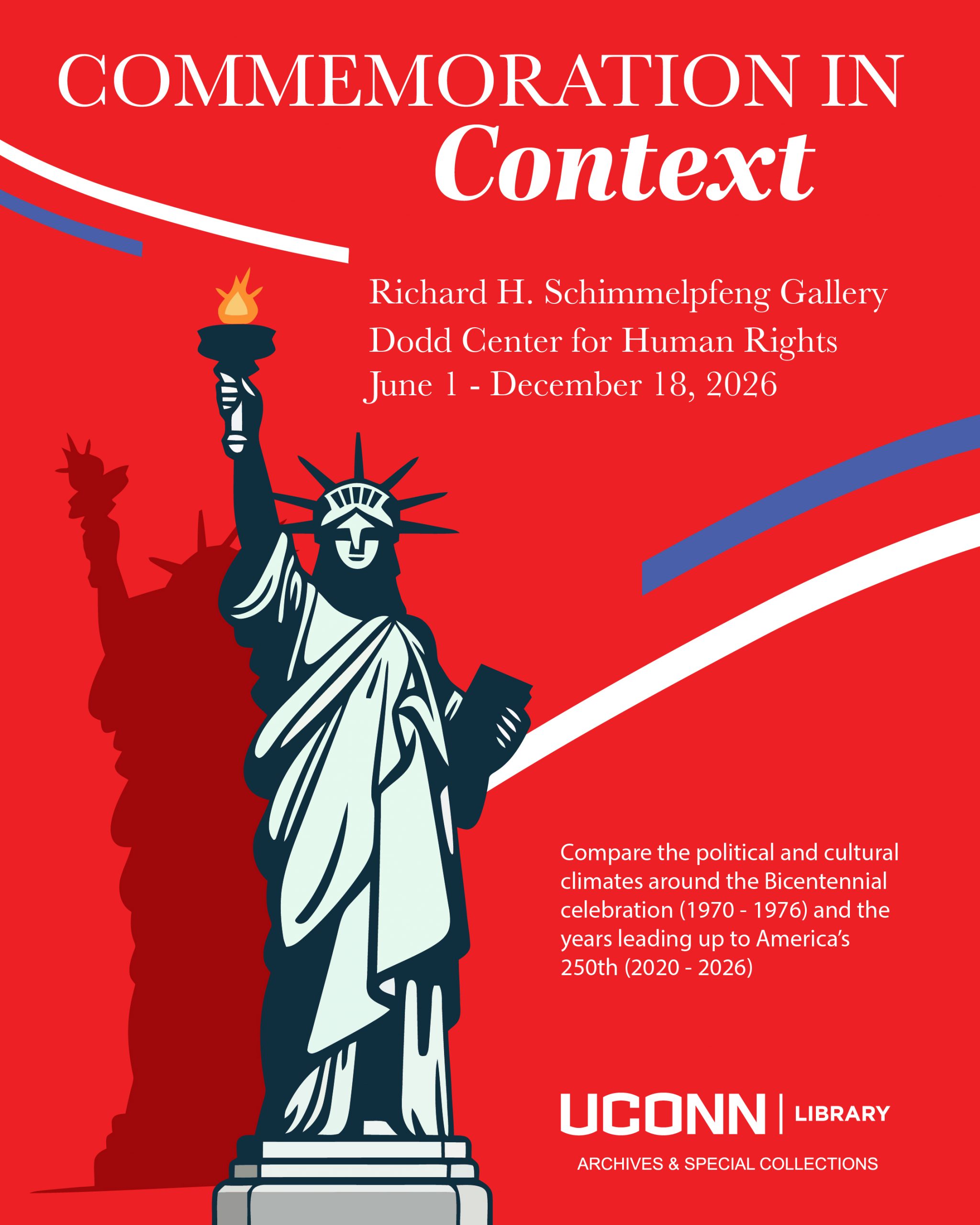 Commemoration in Context
Richard Schimmelpfeng Gallery
Dodd Center for Human Rights
Monday - Friday, 9am to 4pm
June 1 – December 18, 2026
The exhibit compares the political and cultural climates around the Bicentennial celebration (1970 - 1976) and the years leading up to America's 250th (2020-2026).
You can learn more at our Archives & Special collection podcast show d'archive with curator Kara Flynn. A digital version of the exhibit is also available.
Homer Babbidge Library
 Threads of Identity: A Showcase of UConn’s Cultural Centers & Programs
Norman D. Stevents Gallery on the Plaza
Homer Babbidge Library
on display through December 31, 2026
Reception - Thursday, September 17 - 11am-12:30pm
UConn cultural centers provide essential spaces, services, and programs that support the social, cultural, and academic needs of students. Through resources, outreach, advocacy, education, and community building, the cultural centers help establish a strong foundation for meaningful engagement across UConn’s diverse campus community.
By celebrating the ethnicities, nationalities, religions, and cultural experiences of each community, the cultural centers create opportunities for students from historically marginalized groups to share perspectives, build understanding, and feel affirmed. These centers challenge stereotypes while fostering an environment of belonging and inclusion at UConn.
Online Exhibits

25 for 25: Celebrating Twenty-Five Years of Collecting
Online Exhibition, UConn Archives & Special Collections
Archives & Special Collections presents 25 for 25: Celebrating Twenty-Five Years of Collecting, a virtual, year-long exhibition celebrating collections and collecting. 2020 marks the 25th anniversary of the dedication of the Dodd Center for Human Rights, which brought together the collections and practices of the University’s Historical Manuscripts & Archives and Special Collections departments for the first time. Over the course of a year, Archives & Special Collections staff will explore 25 objects selected from the collections, engaging with and reflecting on the meaning of these objects and the activity of collecting over time. Through these objects, Archives & Special Collections celebrates the act of historical preservation and the recognition that collections constantly evolve, grow, and expand so that future educators, students, researchers, and learners may be inspired and informed by the objects within.
 The American Approach to Montessori Teaching and Learning
Online Exhibition, UConn Archives & Special Collections
The Montessori method of education was first introduced to the United States in the early 1900s yet quickly fell out of favor with American educators. Widespread American interest in Montessori did not return until the 1950s, thanks in large part to teacher Nancy McCormick Rambusch. Rambusch founded the American Montessori Society in 1960, which sought to promote the Montessori method in the United States. AMS succeeded in reviving the Montessori method in the United States and gaining recognition for it as a valid educational system. This exhibit explores the origins of the Montessori movement in the United States and the Americanization of the Montessori method. It is comprised of materials from the American Montessori Society Records, which were donated to the UConn Archives in 2006 and digitized beginning in 2016.
 Homefront: Connecticut Businesses in World War II
Online Exhibition, UConn Archives & Special Collections
The outbreak of World War II dramatically changed Connecticut businesses. Long a vibrant part of New England industry, local firms switched from making clocks and wool coats to mass producing artillery cartridges and Army pea-coats. Selections from the Connecticut business collections held by the University of Connecticut’s Archives & Special Collections paint a detailed portrait of this remarkable moment in history through the lives of the people who lived it.